
I asked an AI to draft a summary of a board deck I'd been working on for two weeks. It took eleven seconds. The structure was clean, the language was tight, and it was better than my first draft.
My second reaction was less comfortable: if the tool can do this, what exactly was I doing for two weeks?
I don't think I'm the only one sitting with that question. Whether you're in marketing, finance, law, or operations, the pattern is the same: a task that once proved you were good at your job now proves you have a laptop and a subscription.
- The flattening effect
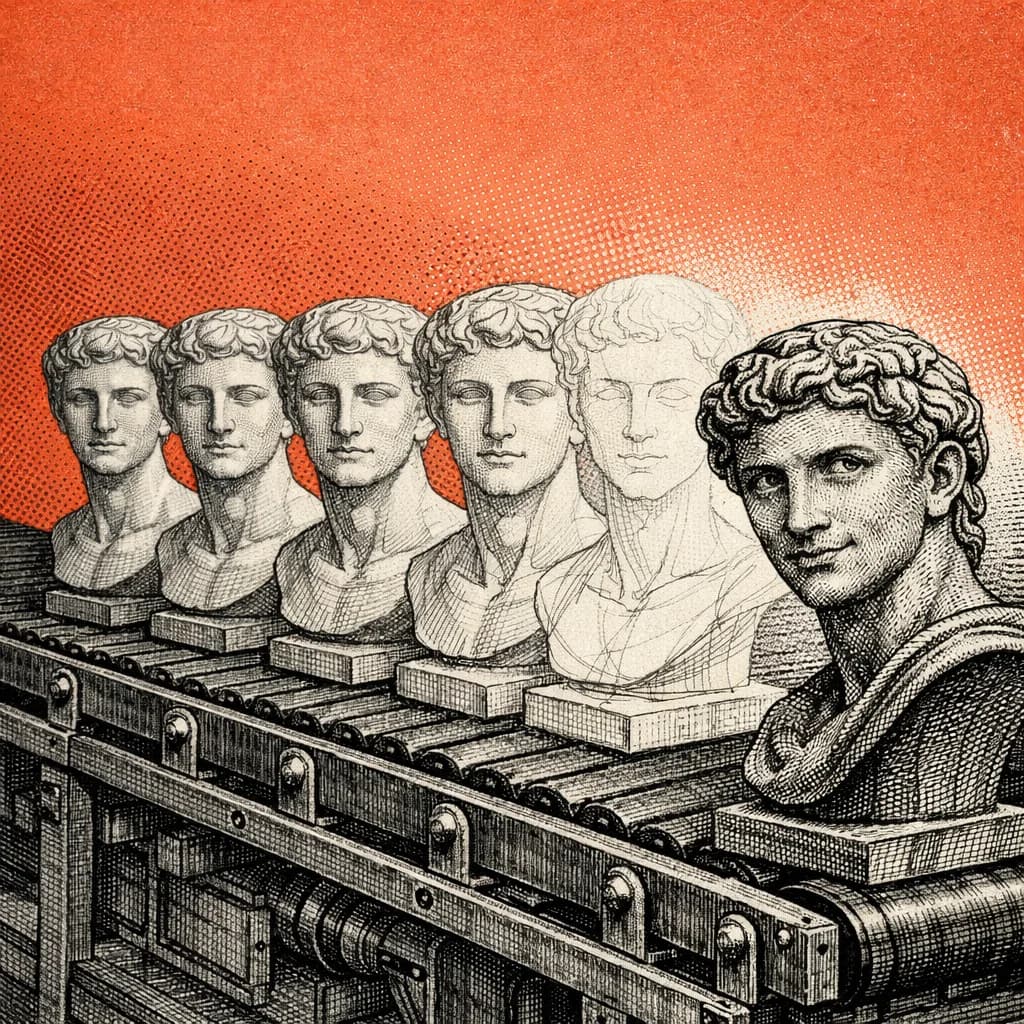
When AI brings most professionals to "good enough" on most knowledge-work tasks, baseline competence stops being a differentiator. Your edge moves from what you produce to who you are as a professional: your judgement, taste, and point of view.
- AI is automating the task layer of knowledge work at speed. What it can't replicate is how you think, what you notice, and why you care.
- When baseline competence becomes cheap, your edge moves from what you produce to who you are as a professional: your judgement, taste, and point of view.
- The people who thrive won't be those who resist AI or those who outsource their thinking to it. They'll be the ones who use it to free up time for the work only they can do.
AI is mastering the routine part of your job
The numbers are stark. According to McKinsey's November 2025 report, 57% of US work hours are now technically automatable, and the figure is higher for knowledge workers, where generative AI can handle 60 to 70% of tasks that currently fill people's days. Drafting emails. Building reports. Summarising research. Generating first-pass analysis.
The stuff that used to take a smart person a morning now takes a prompt and a few seconds.
This isn't a future scenario. A field experiment by Harvard Business School and Boston Consulting Group put 758 consultants through realistic management tasks with and without AI.
But here's the twist: the researchers found that even highly skilled professionals couldn't predict which of their everyday tasks AI would handle well and which it would botch. They called this uneven boundary the "jagged technological frontier."
The point isn't that AI is coming for your job. It's that AI is coming for the part of your job that used to feel like skill.
When competence is cheap
Here's where it gets uncomfortable. If AI can bring most people to "good enough" on most knowledge-work tasks, then competence itself stops being a differentiator. Think of it this way: if everyone in your team can now produce a decent strategy memo using AI, the memo no longer tells your boss who the strong thinkers are.
The 2025 Stanford AI Index makes this concrete at the model level: the gap between the best-performing AI systems and their competitors has collapsed to near-parity in twelve months. What was state-of-the-art last year is now a baseline. They call it "commoditised brilliance."
The same dynamic applies to people. A study published in Scientific Reports in 2023 found that AI chatbots outperformed the average human on standard creativity tests, generating more original and elaborate responses than most participants. But the best human responses still matched or exceeded the machines. A larger follow-up in 2026, testing over 100,000 people against current AI systems, confirmed the pattern: AI beats the average, but the top 10% of humans still pull away, especially on richer work like storytelling, interpretation, and contextual reasoning.
AI compresses the gap between average and good. It doesn't close the gap between good and distinctive.
That second gap is where your value now lives.
What AI can't copy
So what does "distinctive" actually mean in practice? I think it comes down to three things AI can suggest but can't own.
Judgment
Knowing which option to pick, when to act, and what to ignore.
The politics of the room, the risk appetite of the board, the thing the client said off the record last Tuesday.
Taste
Having a sense of what "good" looks like in your domain.
Built from years of pattern recognition that no training dataset can replicate.
Point of View
The recognisable angle you bring to a problem.
AI can remix existing perspectives. It can't originate one grounded in conviction.
AI can generate ten strategic options for a given problem. A good professional knows which three are worth discussing and which one fits the context that no model has access to. A doctor reading the same scan as an AI still catches what the model can't: the patient's history, the family context, the thing that doesn't quite fit the numbers.
The marketer who truly understands her audience doesn't need AI to tell her what message matters. She uses AI to produce variations, then picks the one that feels right, and that feeling is built from years of pattern recognition that no training dataset can replicate. The same is true for an architect choosing materials, a lawyer framing an argument, or a teacher designing a lesson that actually lands.
Now, someone will argue that AI will eventually master these too. Maybe. But the concession I'd make is narrower than you'd think: AI is getting better at generating plausible judgement, taste, and perspective. What it can't do is stake anything on those calls. It doesn't have a reputation to protect, a career to build, or a team that depends on it being right.
Accountability is the moat around the moat.
AI can be copied. Your perspective can't.
A short playbook for building a human edge
This isn't about resisting AI. It's about using it to clear the low-value work so you can spend more time on the high-value thinking.
Use AI to handle the first draft. Let it write the email, outline the deck, summarise the research. Then ask yourself: what in this feels generic? What would I say differently? Rewrite those sections. That's where your voice lives.
Turn AI into a thinking partner, not an answer machine. When you ask it for an answer, also ask: "Give me three different ways to look at this problem." Then decide which lens you agree with and why. The value isn't in the output. It's in the choosing.
Make your perspective visible. Take one recurring problem at work and write a one-page proposal with your view on how to fix it. Use AI to brainstorm options, but pick the one that reflects your values and context. Over time, these small artefacts show you're not filling a role. You're shaping how your team thinks.
Invest in the work AI can't do. Run better meetings. Build cross-team relationships. Have the conversation that's sensitive enough that no one wants to put it in writing. These are the things that build trust, and trust is the ultimate non-replicable asset.
For years, the career question was: What can you do? What skills do you have, what tasks can you complete, what tools do you know?
That question is losing its power. When AI can do most of the tasks, the differentiating question becomes: Who are you when the tasks are easy?
The people who answer it well won't be the ones who learned the most AI tools. They'll be the ones who used those tools to become more of themselves.
In a world where everyone has the same superpower, being uncopyable might be the only edge left.
Frequently asked questions
- McKinsey Global Institute. A new future of work: The race to deploy AI and raise skills in Europe and beyond. November 2025.
- Dell'Acqua, F. et al. Navigating the Jagged Technological Frontier. Harvard Business School Working Paper No. 24-013, 2023.
- Stanford University. AI Index Report 2025.
- Haase, J. & Hanel, P. Artificial muses: Generative AI chatbots have risen to human-level creativity. Scientific Reports, 2023.